Shop by
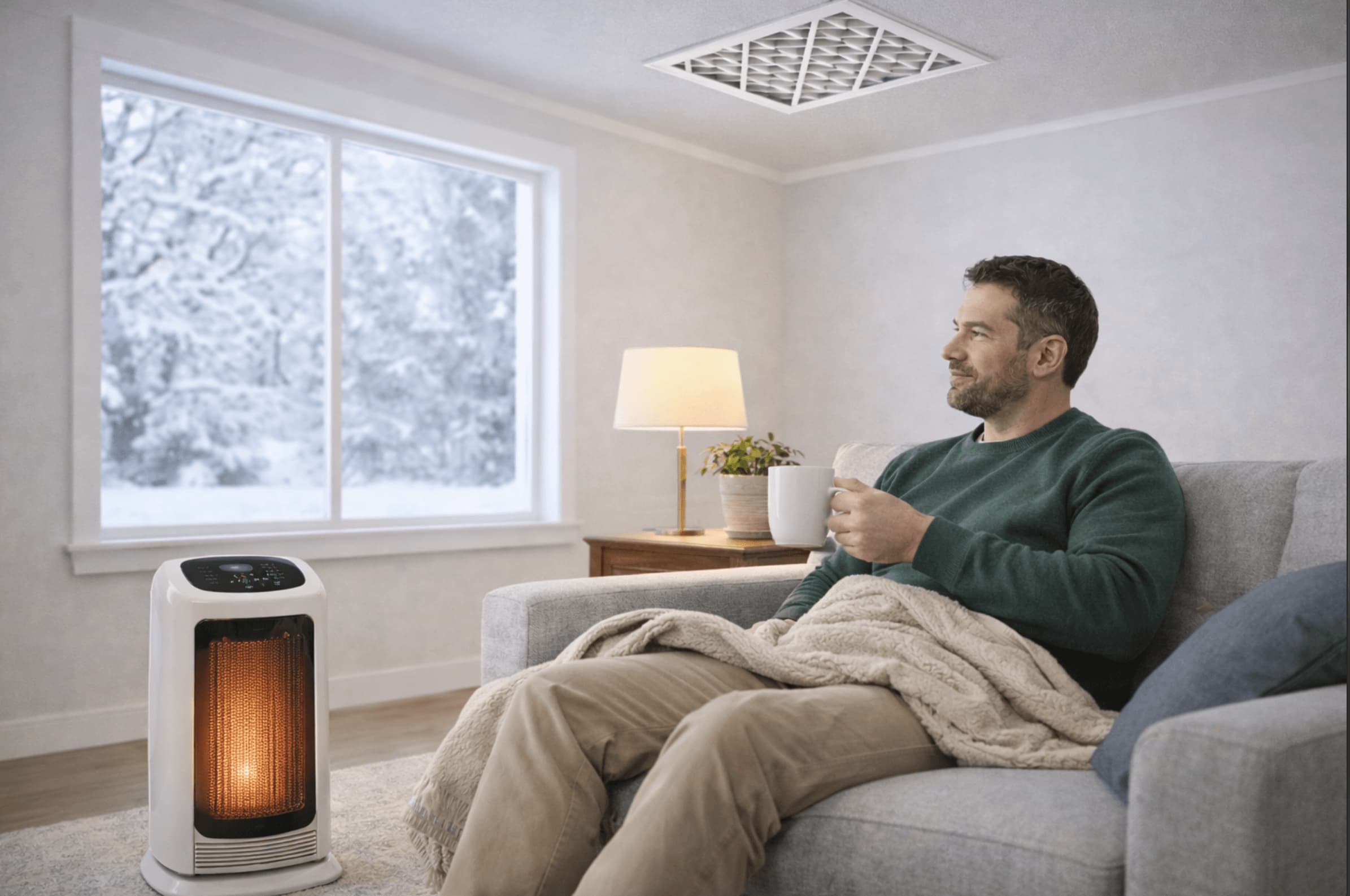
A space heater is the household appliance most likely to start a fatal home fire. Roughly four out of five home heating fire deaths involve one, and almost every fire starts the same way: a heater set too close to a curtain, a couch, or a stack of laundry.
You don't have to swear off space heaters this winter. Used the right way, they're a sensible way to take the chill out of one stubborn room. The trouble starts with one careless habit, and below is the five-minute checklist we walk customers, friends, and family through every cold snap. It covers fire safety, carbon monoxide, and the indoor air quality piece most safety articles skip.
Short on time? Here's what people ask us most:
Are space heaters safe to breathe? An electric model is generally safe. A gas, propane, or kerosene unit puts off carbon monoxide and fine particles, and shouldn't run inside without proper venting.
Do space heaters affect indoor air quality? Yes. Even electric ones dry out the air and stir up dust that's been sitting on surfaces. Fuel-burning units add carbon monoxide, nitrogen dioxide, and PM2.5 to the room.
How far should things be from a space heater? Three feet, all the way around. This single rule prevents most heater fires.
Can I leave a space heater on overnight? No. Turn it off any time you leave the room or go to sleep.
What's the safest heater for a bedroom? An electric model with a UL, ETL, or CSA certification mark, plus tip-over auto shut-off and overheat protection.
If you remember five things from this guide, make it these:
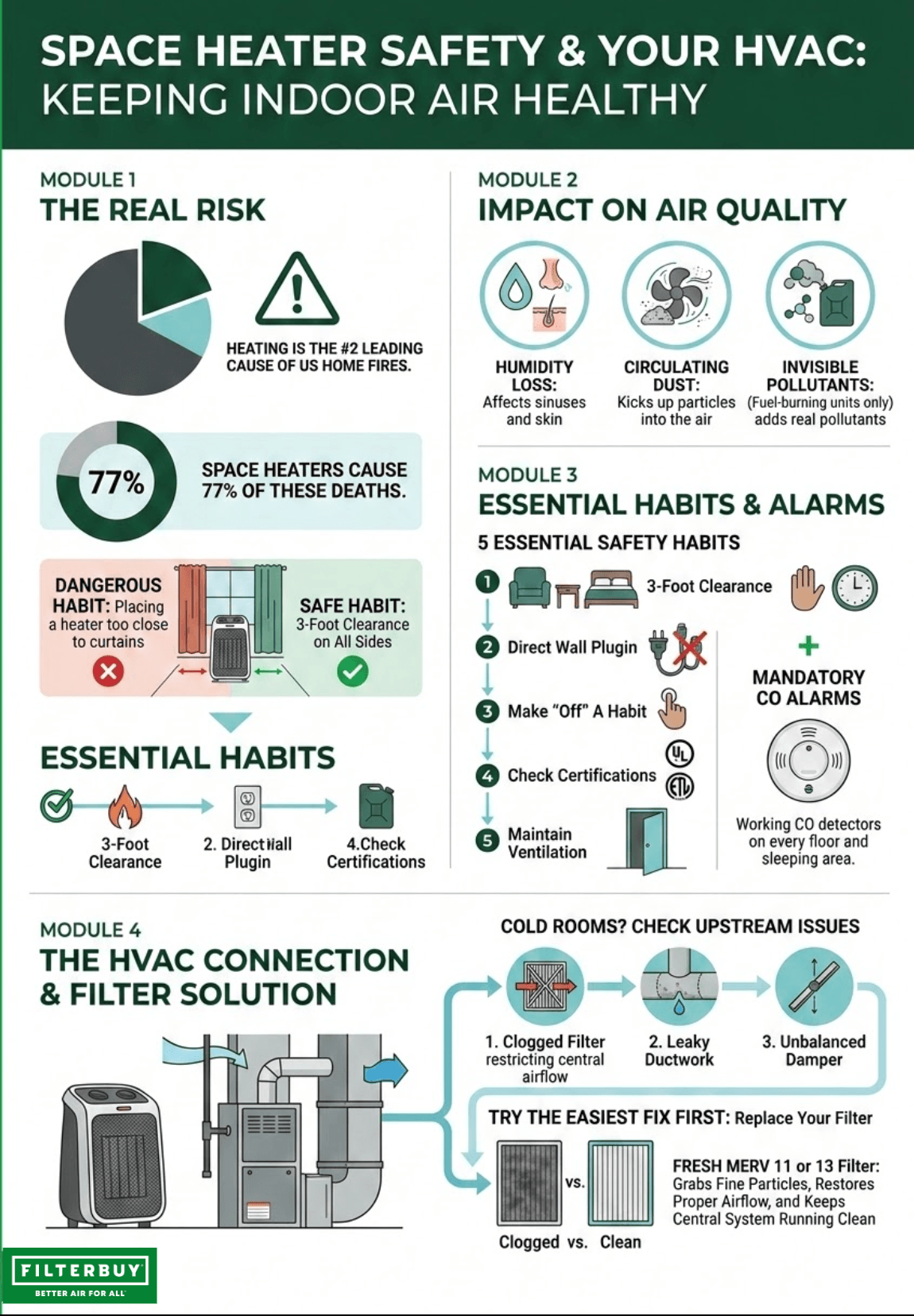
• Three feet of clearance, on every side. Curtains, bedding, furniture, paper, pets, and people all need that buffer.
• Plug straight into the wall. No extension cords. No power strips. Heaters pull too much current for either.
• Electric is the safest option indoors. Fuel-burning models belong outside or in spaces specifically rated and vented for them.
• A working CO detector is the price of admission. Anyone using fuel-burning equipment indoors needs one outside every sleeping area.
• A clean HVAC filter does the heavy lifting. Heaters stir up dust and pollutants. The filter is what catches them before you breathe them in.
Heating equipment is the second-leading cause of U.S. home fires, after cooking. Within that group, space heaters and heating stoves cause about 29% of the fires but roughly 77% of the deaths. Almost half of those fires happen between December and February. The single most common cause is a heater set too close to something that can burn.
That last part is what makes the data so frustrating, and what makes most of it preventable. A heater placed correctly, plugged in correctly, and switched off when no one is in the room rarely starts anything.
Common question, and the answer depends entirely on what's burning inside the unit (or whether anything is burning at all).
Electric heaters are the safest indoor option. There's no combustion happening, so no carbon monoxide and no particulates thrown into the air by the heater itself. The air-quality concern with electric heaters is indirect: they dry out the air and circulate dust that was already in the room.
Gas, propane, and kerosene heaters produce carbon monoxide, nitrogen dioxide, and fine particulate matter as part of normal operation. A lot of these models carry "outdoor use only" labels for that reason. Running an unvented fuel-burning heater inside is the most common way people get carbon monoxide poisoning from supplemental heat. If you're using one indoors, it has to be a vented model designed for indoor operation, with a working CO detector in the room.
Infrared and oil-filled radiators are sub-types of electric heaters. They're safe to breathe and tend to run cooler on the surface, but the same fire-safety rules apply: 3-foot clearance, no extension cords, never left running unattended.
Whether you're shopping for a new heater or auditing what's already in the closet, look for these on the label and the unit itself:
• Tip-over auto shut-off
• Overheat protection
• A cool-touch exterior
• A UL, ETL, or CSA safety certification
• A timer or thermostat
• A heavy, weighted base
• A three-prong grounded plug, and never use an adapter to bypass it
Anything missing tip-over protection or a recognized safety lab's mark should be retired. A new certified unit costs less than a hundred bucks. A house fire costs everything else.
1. Three feet of clearance, on every side. Curtains, bedding, furniture, paper, pets.
2. Plug straight into the wall. Skip extension cords and power strips. Heaters pull too much current for either.
3. Pick a dedicated circuit when you can. Don't share the outlet with other heat-pulling appliances.
4. Flat, hard, non-flammable surface. Tile or hardwood. Never carpet, never on top of furniture.
5. Never run unattended. That includes overnight, even with the door open.
6. Inspect the cord and plug before every use. A warm plug, a frayed cord, or scorch marks mean the heater goes in the trash.
7. Set a 3-foot kid- and pet-free zone. Active supervision any time the heater is running.
8. Make "off" a habit. When you leave the room. When you go to bed. When you step out for the mail.
Carbon monoxide doesn't have a smell, a color, or a taste. By the time someone notices the symptoms (headache, dizziness, nausea, confusion, fatigue that feels like the flu), they may already be in serious trouble. The CDC reports that most U.S. carbon monoxide incidents happen between November and February, and fuel-burning supplemental heaters are a regular source.
Anyone using a fuel-burning heater, a wood stove, or even just a gas furnace needs working CO detectors in the house. Put one on every floor and outside every sleeping area. Test them monthly. Replace the whole unit every five to ten years per the manufacturer.
When a CO alarm sounds, get everyone outside immediately and call 911 from outside the house. Don't open windows and try to air it out first. The point is to get help in to confirm the room is safe to re-enter, and ventilating early just delays that.
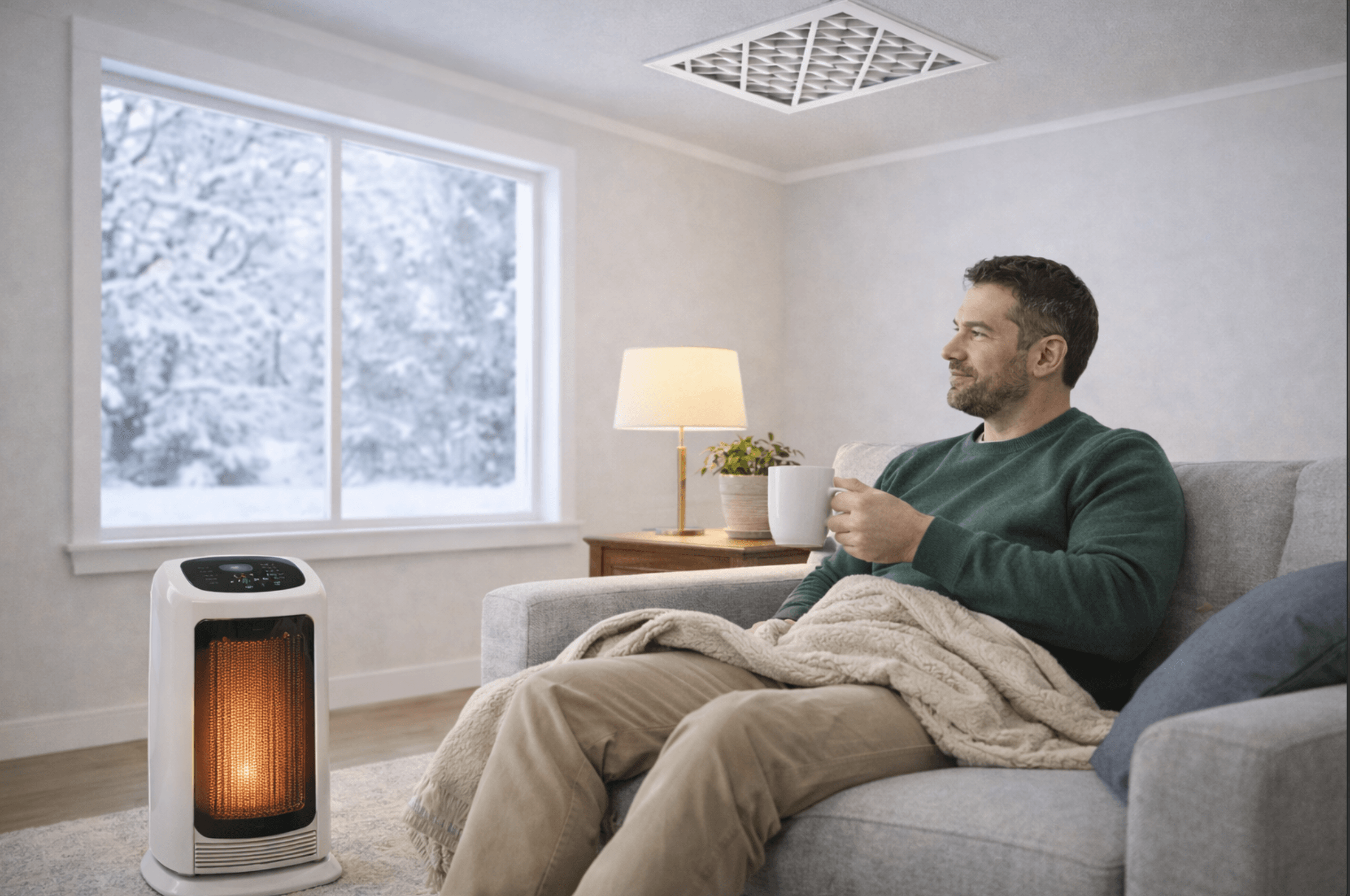
Even a perfectly safe electric heater can quietly drag down the air in your home. Four things tend to happen when a heater runs in one room:
• It pulls humidity out of the air in that room, which can make sinuses, skin, and breathing feel worse.
• It kicks up dust, dander, and allergens that had been sitting on surfaces.
• It throws off your thermostat reading. If the room with the heater is warm, the central system runs shorter cycles everywhere else, leaving cooler rooms cold and pushing more dust through return vents trying to compensate.
• Fuel-burning units add real pollutants to the air (carbon monoxide, nitrogen dioxide, PM2.5) in quantities small enough to be invisible but large enough to register on a home air quality monitor.
The fix is straightforward. A high-efficiency MERV 11 or MERV 13 filter is built to grab the fine particles a space heater puts into circulation. A clean filter also keeps the central system running efficiently when supplemental heat is in play, which means less dust circulating and lower energy bills overall.
Before winter hits hard, this is also the right moment to prep your HVAC system for freezing winter weather. A fresh filter and a quick once-over of your system can prevent the cold-room problem that has you reaching for a space heater in the first place.
Airflow matters as much as placement. A few small adjustments change how safely a heater operates and how much it affects the rest of your home's air.
• For electric heaters, leave the door slightly cracked so air moves between rooms. Sealing one room off is what causes the humidity drop and dust buildup.
• For fuel-burning models, only run them in spaces specifically rated for indoor use, with the manufacturer's required venting in place.
• Run your central HVAC fan in "on" mode periodically (even when the heat itself is off) to keep whole-home air moving through your filter.
• In a room your central system can't quite reach, an electric heater paired with a portable HEPA air purifier is a solid combination.
Whole-home heating, ventilation, and air conditioning systems are designed to balance temperature, humidity, and filtration across every room. A space heater short-circuits that balance in one room. Fine occasionally, worth thinking about as a long-term fix if you're doing it every night.
Some homes need a space heater in the same room every winter. That usually means something upstream is off. Cold rooms are typically a symptom, not the actual problem. The most common culprits we see:
• A clogged filter restricting airflow through the central system
• Leaky ductwork losing heat between the furnace and the vent
• Unbalanced dampers sending too little air to one zone
• An aging system that can't keep up on the coldest days
Try the cheapest fix first: a fresh, properly-sized HVAC filter. If that doesn't solve it, schedule HVAC service before reaching for a portable heater again.
"After more than a decade of building filters in the U.S. and answering homeowner calls, the same pattern shows up every winter. Homeowners think of a space heater as a standalone appliance, when it actually shares the air, the wiring, and the workload with the rest of the house. Treat it as part of your HVAC system, and most of the safety and air-quality risks go away."
— Filterbuy IAQ Team
These are the authoritative sources we lean on when researching home heating safety and indoor air quality. Bookmark them, because they get updated regularly and are worth a winter read-through.
1. NFPA — Safety with Heating Equipment. The National Fire Protection Association's primary hub for home heating safety guidance. https://www.nfpa.org/education-and-research/home-fire-safety/heating
2. CPSC — Seven Highly Effective Portable Heater Safety Habits. The Consumer Product Safety Commission's plain-language safety checklist for portable heaters. https://www.cpsc.gov/Safety-Education/Safety-Guides/Home/Seven-Highly-Effective-Portable-Heater-Safety-Habits
3. U.S. Fire Administration — Heating Fire Safety. USFA's fire-prevention resource hub, including data on residential heating fires. https://www.usfa.fema.gov/prevention/home-fires/prevent-fires/heating/
4. EPA — Winter Weather and Indoor Air Quality. The Environmental Protection Agency's guidance on protecting indoor air during cold-weather months. https://www.epa.gov/emergencies-iaq/winter-weather-and-indoor-air-quality
5. CDC — Carbon Monoxide Poisoning Basics. The Centers for Disease Control and Prevention's reference for CO symptoms, prevention, and detector placement. https://www.cdc.gov/carbon-monoxide/about/index.html
6. American Red Cross — How to Heat Your Home Safely. Practical winter heating safety tips from the Red Cross. https://www.redcross.org/about-us/news-and-events/news/2024/how-to-heat-your-home-safely-as-cold-weather-sets-in.html
7. National Safety Council — Fire Safety. NSC's home fire prevention overview, including space heater guidance. https://www.nsc.org/community-safety/safety-topics/emergency-preparedness/fire-safety
The numbers below come straight from the federal agencies and nonprofits that track residential fire and CO data. They're worth knowing, and worth sharing with anyone in your house who reaches for the space heater this winter.
1. Space heaters cause the vast majority of fatal home heating fires. Per NFPA's most recent Home Heating Fires research, U.S. fire departments responded to an annual average of 38,881 home heating equipment fires from 2019–2023. Space heaters and heating stoves were involved in nearly one-third (29%) of those fires but accounted for roughly 77% of associated deaths.
(Source: NFPA, Home Heating Fires) https://www.nfpa.org/education-and-research/research/nfpa-research/fire-statistical-reports/heating-equipment
2. Portable heaters are 3% of heating fires but cause 41% of fatal heating fires. From 2017–2019, portable heater fires accounted for just 3% of all heating fires in residential buildings, but they were responsible for 41% of the fatal ones. The U.S. Fire Administration estimates an annual average of about 1,100 portable heater fires, 65 deaths, and $51 million in property loss.
(Source: U.S. Fire Administration, Portable Heater Fires in Residential Buildings) https://www.usfa.fema.gov/prevention/home-fires/prevent-fires/heating/
3. Portable heaters cause an average of 1,700 fires and 70 deaths per year. The Consumer Product Safety Commission estimates that portable heaters, including electric space heaters, were involved in an average of 1,700 fires per year, resulting in roughly 70 deaths and 160 injuries annually from 2017–2019.
(Source: U.S. Consumer Product Safety Commission) https://www.cpsc.gov/Newsroom/News-Releases/2023/CPSC-Warns-Consumers-to-be-Cautious-When-Using-Space-Heaters-Furnaces-and-Fireplaces-This-Winter
Space heaters catch more blame than they probably deserve. An electric, certified unit plugged straight into the wall, with three feet of clear space and an off-switch habit, is a perfectly reasonable supplement to a central system that struggles on the coldest nights of the year.
The trouble isn't the appliance itself but the small shortcuts most people make without thinking: running an extension cord because the outlet's across the room, scooting the heater closer to the bed because it feels warmer that way, firing up a propane unit indoors during a power outage "just for tonight." Those are the moments worth catching.
The other piece worth saying out loud: this conversation needs to include indoor air quality, not just fire safety. A heater that never starts a fire can still drag down the air your family breathes for months on end. That's the part most safety guides skip. Pair any supplemental heat with a clean MERV 11 or 13 filter, working CO detectors, and a thermostat strategy that lets your central system do its actual job.
Take five minutes today and do these in order:
1. Walk through the house and check every heater. Tip-over protection, overheat shut-off, an undamaged cord, a safety lab mark on the label. Anything that fails one of those gets retired today.
2. Reset the 3-foot zone everywhere a heater might run. Move curtains, bedding, throw rugs, and anything paper out of the way before plug-in.
3. Test every smoke and CO alarm in the house. Hit the test button. If the unit is more than five years old (or ten for sealed-battery models), replace it.
4. Pull the HVAC filter and look at it. If it's gray or you can't remember the last swap, change it today. Bump up to MERV 11 or 13 if you're running a heater regularly.
5. Set a recurring monthly reminder to retest your alarms. Same day every month, on whatever calendar you actually check.
6. If you're always reaching for the heater, book an HVAC tune-up. The fix is usually upstream of the cold room.
No. Both NFPA and CPSC recommend turning the heater off any time you leave the room or go to sleep. Most fatal heating fires happen overnight, when nobody's awake to catch a problem early. If you need warmth while you sleep, layer up with bedding and adjust the central thermostat instead.
Depends on your furnace fuel and how many rooms you're heating, but the savings are usually smaller than people expect. Electric resistance heat is one of the more expensive ways to make BTUs. If you're running heaters in multiple rooms every night, you may end up spending more than you would just running the central system.
Electric heaters don't add pollutants on their own, but they do dry out the air and stir up settled dust and allergens. Fuel-burning heaters (gas, propane, kerosene) release real pollutants, including carbon monoxide and fine particulate matter, and shouldn't be used indoors without proper venting. A high-efficiency HVAC filter (MERV 11 or 13) helps capture the fine particulates either type can put into circulation.
At least three feet, on every side. This is the single most-cited safety rule from NFPA, CPSC, USFA, and the Red Cross, and it's also the most commonly broken one. Curtains, bedding, upholstered furniture, throw rugs, paper, and clothing all need that buffer.
No. Space heaters draw enough current to overheat most power strips and extension cords, which is a leading cause of heater-related fires. Plug the heater directly into a wall outlet, and ideally into a dedicated circuit rather than one shared with other high-draw appliances.
An electric model that's UL, ETL, or CSA listed, with both tip-over auto shut-off and overheat protection. An oil-filled radiator or a ceramic unit with a cool-touch exterior fits a bedroom well because the surface stays cooler. Never use a fuel-burning heater in a bedroom, and never run any heater while you're asleep.
Symptoms are flu-like and easy to miss: headache, dizziness, weakness, nausea, chest pain, and confusion. The catch is that CO has no smell or color, so you can't sense a leak on your own. The only reliable way to know is a working CO detector. If yours sounds, or you suspect exposure, get everyone outside immediately and call 911 from outside the home.
Running the central HVAC fan in the "on" position periodically is a good idea. It keeps whole-home air circulating through your filter, which captures the dust and particulates a space heater stirs up in one room. Just be aware it'll equalize temperatures across the house, which can pull warmth out of the room you're trying to heat.
Running a space heater this winter means your HVAC filter is working harder than usual. A fresh, properly-sized MERV 11 or 13 grabs the fine particles a heater puts into circulation and keeps your central system running clean.
We make every filter in the U.S., ship factory-direct, and stock more than 600 sizes. Find your size in a few clicks, and set up auto-delivery so the next one shows up before you need it.

