Shop by

The fiberglass filter sitting in your furnace right now was built for one job: keeping the blower motor clean. It does that well. What it doesn't do, at all, is clean the air your family breathes from November to March. That gap is why the same question lands in our inbox every winter: fiberglass or pleated?
Short version from the team that makes both. For the vast majority of homes, pleated wins. Pleated catches the particles that make a house feel stale by February, it protects your furnace better over a long heating season, and it usually costs less per month once you account for how often fiberglass has to be swapped.
Fiberglass still has a spot on the shelf. If your furnace is older, undersized, or sensitive to any airflow restriction, fiberglass can be the right choice, provided you're disciplined about monthly changes. We'll walk through when that applies.
We manufacture both types of filter in Alabama, Florida, Pennsylvania, and Utah, and we've shipped millions of them since 2013. The advice on this page isn't a ranking pulled from a review site. It's what we tell our own families when the heat kicks on.
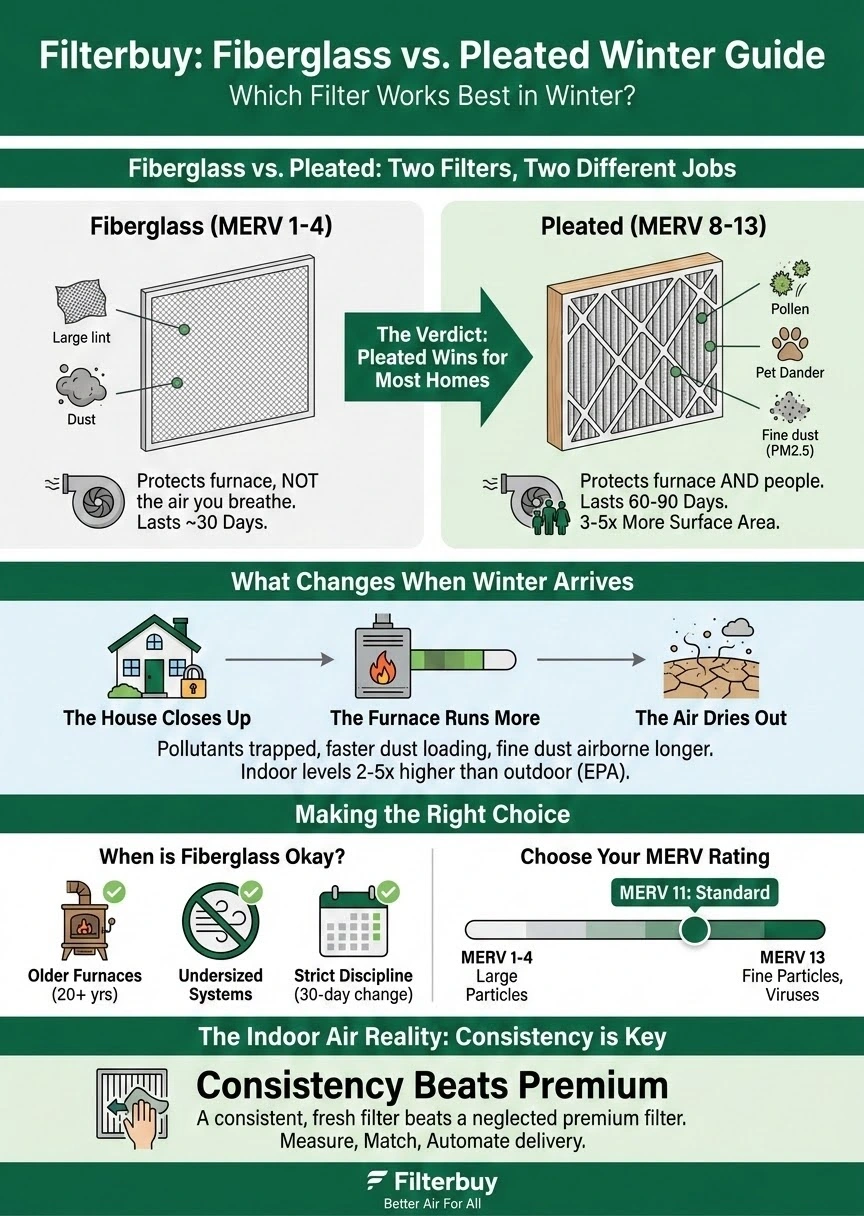
For most homes in winter, pleated beats fiberglass. We manufacture both, so we have no reason to favor one. A pleated MERV 8 to 13 filter catches the pollen, pet dander, and fine dust that slip right past fiberglass. Fiberglass has one job: protecting the blower motor, not cleaning the air your family breathes.
Best for most modern homes: MERV 11 pleated.
Best for allergies or asthma: MERV 13 pleated.
Fiberglass still works for furnaces over 20 years old or undersized systems, changed every 30 days without fail.
Pleated lasts 60 to 90 days between changes. Fiberglass lasts 30, no exceptions.
The same verdict, in sentence form.
Different tools for different jobs. Fiberglass protects the furnace. Pleated protects the furnace and the people inside the house. Pick based on what you actually want the filter to do.
MERV 11 pleated is the winter default for most homes. Strong particle capture, low airflow impact on modern systems, and 60 to 90 days between changes.
MERV 13 if anyone in the house has allergies, asthma, or a respiratory condition. It's the rating health organizations like the American Lung Association point toward for residential use.
Fiberglass works, but only with discipline. It's a reasonable pick for older HVAC or strict budgets, but it has to be changed every 30 days without fail or it stops doing even its basic job.
The real winter filter mistake isn't choosing fiberglass over pleated. It's forgetting to change whichever one you picked. A consistent cheap filter beats a neglected premium filter every single time.
Auto-delivery exists because memory is the weakest part of this system. Remove the remembering, and every filter you pick works better.
Three things change the moment the heater takes over from the AC, and all three change what your filter has to do:
The house closes up for months. Windows stay shut, weatherstripping does its job, and every pollutant that drifts in or gets kicked up indoors stays with you until spring.
The furnace runs a lot more. A filter that could handle 4 hours of daily runtime in October has to hold up at 12 or 18 hours a day in January. Dust loads faster, and airflow resistance climbs faster, which means the change-out schedule tightens.
The air dries out. Dry winter air keeps fine dust airborne longer. Combustion byproducts from gas ranges and water heaters stick around. Anyone with allergies or asthma feels the difference within a week.
Picture the two screens on a back door. A standard window screen lets a lot through. Bigger bugs, sure, but gnats and dust slip right past. A fine mesh insect screen catches almost everything, and because the weave is tighter and the surface area is larger, it holds up longer before it clogs.
That's fiberglass versus pleated in one sentence.
A fiberglass filter is a thin mat of spun glass fibers inside a cardboard frame. It's the cheap, typically one-inch filter most big-box stores stack on an endcap. On the MERV scale, it sits at the bottom, around MERV 1 to 4. That's enough to catch lint and the largest dust particles. It isn't enough to catch pollen, pet dander, smoke, or the fine particulate (PM2.5) most relevant to your lungs.
A pleated filter folds its media into an accordion. That shape gives you three to five times more surface area inside the same frame, which means it holds more dust before airflow suffers and lasts 60 to 90 days instead of 30. Our pleated line covers MERV 8, 11, and 13, plus an Odor Eliminator option with activated carbon for smoke and cooking smells.
Most comparison articles simplify this down to "fiberglass has lower resistance, so it's easier on the furnace." That's technically true on the first day of a fresh filter. It's also misleading, because almost nobody runs a fresh filter for very long.
Here's what actually happens over a winter. A fresh fiberglass filter starts at very low resistance. By day 30, if you've forgotten to change it (and most of us do, because we're human), its resistance has climbed above that of a clean MERV 11 pleated filter. A pleated filter, meanwhile, loads gradually and stays inside a healthy resistance range for 60 to 90 days.
That's the real comparison. A clean, cheap filter beats a dirty, expensive one. A clean pleated filter beats a fiberglass filter at almost every practical point in its lifecycle.
Three scenarios, in order of how often we see them:
The furnace is twenty or more years old. Older blowers often can't push air through the resistance of a dense pleated filter, especially at MERV 13.
The system is undersized or has airflow issues. If your HVAC tech has flagged this during a tune-up, don't upgrade on your own. Ask what MERV ceiling they recommend.
Tight budget plus a monthly habit you actually keep. If you know you'll swap the filter on the first of every month without fail, fiberglass is workable. If "I'll do it this weekend" tends to become "wait, was that January?" then go pleated and save yourself the grief.
For the detailed walkthrough, see our winter MERV rating guide. For a quick pick:
Older furnace, no pets, no allergies: MERV 8 pleated or fiberglass changed monthly.
Modern furnace, typical household: MERV 11 pleated. Our most-shipped filter by a wide margin.
Allergies, asthma, pets, or wildfire exposure: MERV 13 pleated.
Persistent cooking smells, smoke, gas appliances: Odor Eliminator with activated carbon.

"After 30-day side-by-side loading tests on used customer filters in identical HVAC setups, the pattern shows up every time: the pleated unit comes out packed with pet dander and fine dust, and the fiberglass comparison comes out almost clean because everything it was supposed to catch went right past it into the house."
— Filterbuy Manufacturing Lead, 10+ years in residential filter production and QA
Seven places worth bookmarking if you want to go deeper. All links lead to government agencies, major health nonprofits, or our own in-depth guides.
EPA, Guide to Air Cleaners in the Home. The government's plain-language walkthrough of furnace filters, MERV ratings, and portable air cleaners: epa.gov/indoor-air-quality-iaq/guide-air-cleaners-home
EPA, What Is a MERV Rating? A short, authoritative explanation of the MERV scale and which rating to target: epa.gov/indoor-air-quality-iaq/what-merv-rating
American Lung Association, Air Cleaning. Independent, health-first guidance on furnace filters from a non-profit focused on lung health: lung.org/clean-air/indoor-air/protecting-from-air-pollution/air-cleaning
American Lung Association, Particulate Matter Indoors. Why PM2.5 matters, where it shows up indoors, and what the right filter does about it: lung.org/clean-air/indoor-air/indoor-air-pollutants/particulate-matter
ENERGY STAR, Heat and Cool Efficiently. Official HVAC efficiency guidance, including why filter condition directly affects your energy bill: energystar.gov/saveathome/heating-cooling
U.S. Department of Energy, Air Conditioner Maintenance. The same filter-change logic applies to your furnace in winter. Covers change cadence, airflow, and overall system health: energy.gov/energysaver/air-conditioner-maintenance
Filterbuy, What MERV Rating for Winter Air Filter. Our in-depth winter MERV walkthrough, with specific picks for pet households, allergy sufferers, and older furnaces: filterbuy.com/resources/winter/winter-filter-buying-guides/what-merv-rating-for-winter-air-filter
Three numbers that reframe this choice. All sourced from U.S. government agencies or a major health nonprofit.
The EPA's long-running Total Exposure Assessment Methodology studies found levels of common organic pollutants were two to five times higher inside homes than outside, whether the home was rural or industrial. In winter, with the house sealed and the furnace recirculating the same air all day, that gap widens. Your filter is the most accessible tool for closing it. Source: EPA, The Inside Story: A Guide to Indoor Air Quality.
The American Lung Association, echoing EPA research, notes that Americans spend roughly ninety percent of their time indoors on average. That means indoor air quality is effectively the air quality that matters to your health. In winter, that share creeps even higher. A filter upgrade isn't cosmetic. It changes the air you breathe for twenty-plus hours a day. Source: American Lung Association, Let the Air In.
The U.S. Department of Energy estimates that about forty-three percent of a home's utility bill goes to heating and cooling. The filter is the cheapest, fastest-to-change component in that entire system. Keeping it clean and right-sized is one of the highest-payoff maintenance tasks you can do at home. A clogged filter forces the blower to work harder. A properly matched filter lets it run the way it was designed to. Source: U.S. Department of Energy, Why Energy Efficiency Matters.
Here's the thing most of the filter industry won't say out loud: there isn't really a contest. For almost every modern home in a cold winter, pleated is the better filter. We know that, because we make both.
Fiberglass has its place. Older furnaces, tight budgets paired with airtight change habits, and rentals where the furnace isn't yours to worry about long-term. Pitching fiberglass as a general-purpose winter filter, though, oversells what the product was ever designed to do. Fiberglass protects HVAC equipment and does that job well. It doesn't meaningfully improve the air your family breathes, and it doesn't pretend to. That's a feature, not a failure, as long as nobody's selling it as something it isn't.
Pleated, by contrast, does both jobs. It protects the system and catches the particles that affect your health. That's why our most-shipped filter is MERV 11 pleated. It's also what our team uses at home. Pressed for the honest version: MERV 11 for most people, MERV 13 if anyone in the house has a respiratory condition, and Odor Eliminator if there's a specific smell or smoke issue to address.
One last point, and it's the one we keep coming back to: consistency beats premium. A MERV 8 filter changed on time outperforms a MERV 13 filter that's been in the slot since October. Whatever you pick, the actual decision is whether you'll change it on schedule. If that feels like one more thing to remember, hand off the remembering to auto-delivery.
A straightforward path from "I've read enough" to "the right filter is in the furnace."
Pull your current filter. The dimensions are printed on the frame, for example, sixteen by twenty-five by one. If the numbers have worn off, measure height, width, and depth in inches.
Check your furnace manual, or ask your HVAC tech. Most modern residential systems are rated for MERV 13 or below. If you're unsure, start at MERV 8 or 11 and adjust from there.
Match MERV to your household. MERV 8 for basic protection, MERV 11 for typical homes, MERV 13 for allergies and asthma, Odor Eliminator for smoke and cooking smells.
Order the right quantity for the season. A four-pack usually covers a full year for a pleated filter at standard change intervals.
Install the filter with the arrow pointing toward the furnace. Takes under two minutes. No tools needed.
Set up auto-delivery so you don't have to think about it again. Pick your cadence once, and we handle the rest: free shipping, factory-direct, delivered to your door.
For most modern residential furnaces, meaning anything built in the last twenty years, MERV 8 and MERV 11 pleated filters are completely safe. For older systems, start with MERV 8 pleated rather than MERV 11 or higher, and check with your HVAC technician before moving up. The risk isn't "pleated." It's "pleated at a MERV rating your specific system wasn't designed to handle."
At MERV 8 to 11, a clean pleated filter's airflow resistance is modest. The bigger energy story is what a pleated filter prevents: dust building up on your coils, blower, and heat exchanger. Those are the things that quietly make your system work harder over time. Most homeowners break even or come out ahead on energy over a full heating season.
Fiberglass: every 30 days, without exception. MERV 8 pleated: every 60 to 90 days. MERV 11 or 13 pleated: every 60 to 90 days, leaning toward 60 if you have shedding pets or your furnace runs nearly around the clock.
The American Lung Association recommends a MERV 13 filter for home HVAC systems that can handle it, particularly for households with sensitivities or respiratory conditions. The EPA gives similar guidance. For most modern residential furnaces, MERV 13 is well within what the system can accommodate. Check your manual if you're unsure.
Yes, and you'll notice it within the first change cycle. A MERV 11 pleated filter captures roughly twenty times more fine dust than standard fiberglass. In a sealed winter home where the furnace recirculates the same air all day, that difference compounds fast.
One: an older or undersized furnace where airflow resistance is a genuine concern, paired with a homeowner who will absolutely change the filter every 30 days. Outside of that specific situation, pleated almost always comes out ahead on the measures that matter most to your family's comfort and health.
Made in the USA. Over 600 standard sizes on the shelf, plus custom sizes for the homes that need them. Free shipping, factory-direct. Auto-delivery so the next filter shows up before the current one wears out.
Find Your Winter Filter Size. Enter your filter dimensions, and we'll match you to the right MERV rating in under a minute.
Set Up Auto-Delivery. Pick your cadence once, and we'll handle the rest, all winter and all year.
Little effort. Big impact. Clean air, delivered.
Better Air For All.

