Shop by

Your home shouldn’t pay the price for a delicious holiday meal. Here’s how to keep the air clean while you cook.
Swap in a MERV 11 or MERV 13 filter before your first big holiday meal
Run your range hood on high before you start cooking — not after the smoke appears
Crack a window one room over from the kitchen to get real air exchange going
Put a portable air purifier with an activated carbon filter in the living or dining area
Build a 20–30 minute gap between your biggest high-heat cooking events
Yes. High-heat holiday cooking releases VOCs, grease aerosols, and fine particles into sealed winter air — and for anyone who's already congested, that air quality spike hits harder and faster than most people expect.
Why does it happen:
Frying, roasting, and sautéing release compounds, including formaldehyde and acrolein, directly into the air.
Sealed winter windows trap everything indoors — VOC levels can spike up to 10 times higher than outdoor baseline during and after cooking, according to the EPA's TEAM Study.
A full house adds CO₂, body heat, and moisture, reducing effective ventilation further.
An overdue or under-rated filter can't intercept the additional particulate load fast enough.
What helps:
Run the range hood on high before cooking starts — not after.
Crack a window one room over from the kitchen to create real air exchange.
Upgrade to a MERV 11 or MERV 13 filter before the first big gathering — not after the fact.
Your HVAC filter works hardest on Thanksgiving. Holiday cooking is the most intensive indoor air quality event of the year — and most filters aren't ready for it.
Smoke, odors, and VOCs are three separate problems. Air fresheners handle odors only. It takes filtration plus ventilation to address all three.
Install MERV 11 or MERV 13 before the first meal — not after. VOCs spike up to 10x above outdoor levels during cooking (EPA). The upgraded filter needs to be in place before that happens.
Turn the range hood on before cooking starts, not after smoke appears. Leave it running for several minutes after the last dish comes off — VOCs stay elevated in the air long after the stove goes off.
Swap the filter again in January. Holiday cooking fills a filter in 60 days, which normally takes 90. Don't carry a spent filter into the new year.
Your HVAC filter does its heaviest work on Thanksgiving. Turkey at 425°F, four burners going, a house full of guests with the windows sealed against the cold — that’s not what a standard filter was designed for, and most homeowners don’t realize it until someone starts sneezing mid-meal.
Holiday cooking pushes indoor air quality in ways a normal Tuesday dinner never does. Every time you fry, roast, or sauté at high heat, you release visible smoke, cooking odors, and invisible gases called volatile organic compounds — VOCs — all at once. Longer cook times and higher heat mean your exposure on a single holiday is meaningfully higher than on an average weeknight.
Managing all three isn’t complicated, but it takes more than cracking a window or lighting a candle. Good filtration and smart ventilation are the real answer — and this guide walks you through both.
VOC stands for volatile organic compound. These are gases released when certain substances get heated, and your kitchen generates them steadily during the holidays.
Frying bacon, searing a roast, rendering turkey drippings — the oils and fats in your food break down at high heat and send compounds into the air. Formaldehyde, acrolein, and benzene are among the most common cooking byproducts. They’re present in everyday cooking too, but Thanksgiving involves longer cook times, higher heat, and more dishes running at once than almost any other day. The concentration builds.
Smoke, odors, and VOCs are three separate problems that arrive together. Smoke is the visible haze above the pan. Odors are the gases that hit your nose first. VOCs travel through your home with no visible sign at all. An air freshener handles the odors for a few minutes. It does nothing for the other two, which is exactly why understanding the difference matters.
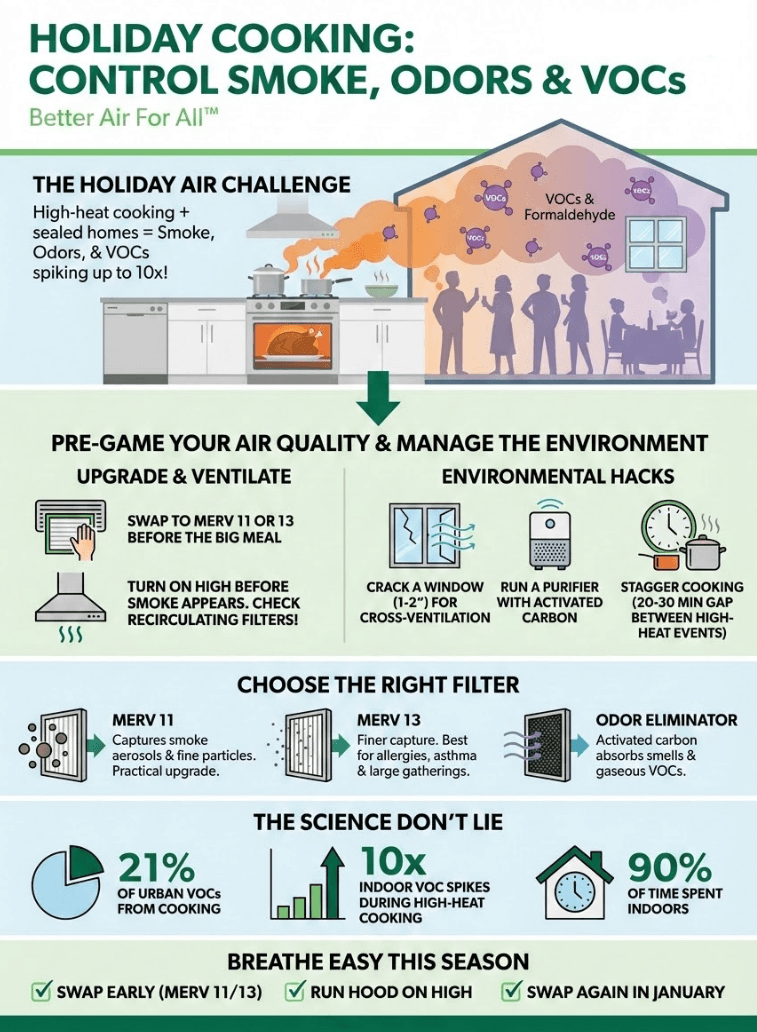
“Holiday cooking at high heat can raise indoor VOC levels well above your home’s normal baseline — especially when the windows stay shut all winter.”
Good filtration paired with active ventilation addresses all three. That’s the target.
Twelve guests exhale a lot of CO₂. Add cooking heat, sealed December windows, and a filter that’s been running since September, and your HVAC system is managing more than it was built to handle at once.
Every person in your home adds to the load on your ventilation system. In summer, you crack a window without thinking. In winter, those windows stay shut, which puts the entire job of filtering and circulating your air on one system running harder than usual on the day it matters most.
For guests dealing with allergies, asthma, or seasonal congestion, that combination hits differently. Watery eyes, a scratchy throat, or a headache that shows up two hours into dinner often isn’t holiday fatigue. It’s indoor air that needs attention.
We hear some version of this from customers every November. “My family starts coughing every time I fire up the oven” is one of the most common things people tell us before Thanksgiving. The fix is usually simpler than they expect, and most of it can be handled before anyone walks through the door.
None of these requires a contractor or a major investment. Most can be taken care of before your first guest arrives.
Your HVAC system can only clean the air as well as the filter you’ve given it. During a typical holiday gathering it’s running harder and longer than usual, pulling in cooking smoke, VOC-carrying aerosols, and fine particles on top of its normal workload.
A MERV 8 filter handles everyday dust, pollen, and pet dander without trouble. Cooking byproducts are a different category. A MERV 11 captures significantly finer particles, including much of what slips right through a basic filter. A MERV 13 goes further still, and is the right call for anyone hosting guests with allergies, asthma, or respiratory sensitivities.
Swap the filter before the holiday cooking season kicks off. Filterbuy’s MERV 11 and MERV 13 filters are made in the USA and ship free, factory-direct to your door. Find your size before the first big meal.
The range hood is the most direct tool for keeping cooking smoke and odors from spreading through your home. Most people turn it on after the smoke is already in the room. Turn it on before you start cooking, run it on high for anything involving frying, searing, or sustained high heat, and leave it running a few minutes after you’re done.
If your hood vents outside, that’s the best-case setup. If it’s a recirculating model that filters and returns air, check the filter inside it. A clogged recirculating hood accomplishes almost nothing, and many homeowners haven’t checked that filter in years.
Cold weather doesn’t mean you have to seal your home completely. A 1–2 inch opening in a room next to the kitchen creates real cross-ventilation. Fresh air comes in, stale air moves out.
One placement note worth knowing: opening a window directly above or beside the stovetop disrupts the range hood’s exhaust draft. Open a window in an adjacent room instead, and let the pressure difference do the work.
In most homes, the kitchen opens directly into a living or dining area. That means cooking VOCs and odors travel to wherever your guests are sitting. A portable air purifier with an activated carbon filter captures gaseous odors and VOCs that a standard HVAC filter can’t reach.
Position it in the living or dining area during cooking and for about an hour afterward. It’s a low-effort addition that makes a noticeable difference in a full room.
Roasting a turkey at 400°F for four hours, then immediately firing up a deep fryer for appetizers, then moving straight to stovetop sides — that sequence layers high-emission cooking events with no recovery time for your filtration system.
A 20–30 minute gap between your biggest high-heat cooking events gives your filter a chance to cycle the air before the next wave hits. Holiday meals are complex, and this isn’t always possible. But where the schedule allows it, the difference is noticeable by the time everyone sits down.
For a deeper look at how winter affects your home’s air beyond the holiday season, read our complete guide to indoor air quality in winter and holiday cooking VOCs.
Before your holiday hosting season begins, check the filter. If it hasn’t been swapped in the past 60–90 days, it’s carrying a full load of accumulated dust with no capacity left for what holiday cooking is about to add.
Here’s a quick breakdown by MERV rating:
MERV 8 — Handles everyday dust, pollen, and pet dander. Works well under normal conditions, but not the right fit for heavy holiday cooking or guests with respiratory concerns.
MERV 11 — The practical upgrade for most homes. Captures fine particles, cooking smoke aerosols, and a wider range of airborne pollutants. Solid swap before Thanksgiving or Christmas.
MERV 13 — Finer particle capture, best suited to households with allergy or asthma concerns, or anyone who hosts large gatherings regularly.
Odor Eliminator — Filterbuy’s activated carbon option is built to absorb cooking odors and gaseous compounds, not just trap particles. Worth it if lingering smells are a recurring issue after holiday meals.
“We’ve shipped millions of filters to families across the country. The ones who swap before Thanksgiving tell us the same thing every year: the holidays just smell better.”
Every Filterbuy filter ships free, factory-direct from the USA — no middlemen, no markups, over 600 standard sizes plus custom options for non-standard systems. And if you’d rather not think about it again, our auto-delivery subscription puts a fresh filter at your door when it’s time to swap. Fewer errands, cleaner air, done.
We’re all about clean air without the homework. But if you’re the type who wants to see the research behind the advice — or you need to explain to someone at the table why you’re cracking a window in December — these are the sources we’d point you to. Every one of them comes from a federal agency, a peer-reviewed journal, or an accredited research institution. No filler, no fluff.
U.S. Environmental Protection Agency (EPA) — Foundational Reference
If you’ve ever wondered what’s actually floating around your kitchen on Thanksgiving, this is the place to get a straight answer. The EPA breaks down what volatile organic compounds are, how they build up indoors, and what health effects are worth knowing about — without drowning you in chemistry.
Source: epa.gov — Volatile Organic Compounds’ Impact on Indoor Air Quality
Indoor Air Journal — Wiley Online Library (2024) — Peer-Reviewed Research
Researchers measured real VOC and particle emissions from frying, roasting, and boiling — with instruments, in a controlled kitchen, across multiple cooking methods. The results make a clear case for why holiday cooking is a different air quality challenge than making Tuesday pasta. Worth bookmarking if you want the data behind the advice.
Source: onlinelibrary.wiley.com — Impact of Cooking Methods on Indoor Air Quality
NOAA Chemical Sciences Laboratory — Federal Research
NOAA scientists found that cooking may account for as much as 21% of the VOCs measured in urban air — a number that surprised even the researchers. It’s a good reminder that what happens at your stovetop doesn’t stay in your kitchen, especially in a closed-up winter home with no fresh air coming in.
Source: csl.noaa.gov — Cooking Emissions & Urban VOC Contributions
U.S. Environmental Protection Agency (EPA) — Filter Selection Guide
MERV ratings can feel like alphabet soup if nobody explains them clearly. This EPA guide does exactly that — covering what the scale measures, how filters are tested, and what each level actually captures. Read this before you swap your filter for the holidays, and you’ll know exactly what you’re buying and why.
Source: epa.gov — What Is a MERV Rating?
Lawrence Berkeley National Laboratory — IAQ Scientific Findings Resource Bank — Technical Reference
Lawrence Berkeley National Lab built this resource specifically to bridge the gap between IAQ science and real-world decisions. It covers VOC chemistry, how different compounds behave indoors, and what the research actually says about health effects — useful for anyone who wants more than surface-level answers.
Source: iaqscience.lbl.gov — Volatile Organic Compounds (VOCs)
National Institutes of Health — PMC (2022) — Clinical Evidence
This review pulled together 69 studies on how indoor air pollution affects people with respiratory conditions — kids, adults with asthma, and anyone with a sensitive airway. The takeaway is practical: for guests who already deal with breathing issues, a loaded filter and poor ventilation on a high-heat cooking day is a real problem, not just an inconvenience.
Source: pmc.ncbi.nlm.nih.gov — Indoor Air Pollution and Vulnerable Groups
U.S. Environmental Protection Agency (EPA) — Homeowner Action Guide
Once you understand the problem, this is where you go to act on it. The EPA’s homeowner guide covers the three things that actually move the needle on indoor air quality: cutting off the source, opening things up for ventilation, and keeping your filter current. No jargon, no filler — just a clear checklist for protecting your home’s air year-round.
Source: epa.gov — Care for Your Air: A Guide to Indoor Air Quality
We’re not asking you to take our word for it. Every number below comes from federal research or peer-reviewed science — and each one lines up with patterns we’ve observed firsthand across millions of filter shipments and years of conversations with customers.
90% of Americans’ time is spent indoors, where air pollutant concentrations are often 2 to 5 times higher than outside
You’re not just cooking dinner on Thanksgiving. You’re cooking inside a sealed home where indoor pollutant levels are already running 2 to 5 times higher than outside before the first burner turns on.
What we observe: Filters on 60-day winter replacement cycles return visibly heavier than any other season, with grease aerosol buildup on the media that doesn’t appear in spring or summer returns.
What the research shows: The EPA confirms Americans spend roughly 90% of their time indoors, where pollutants frequently exceed outdoor levels. That gap widens further during cooking, sealed windows, and high occupancy — the exact combination a holiday gathering creates.
What it means for your home: Your HVAC filter is your primary defense against those elevated indoor concentrations. A loaded or under-rated filter on Thanksgiving isn’t just inefficient — it’s working against the conditions it was never designed to handle.
Source: epa.gov — Indoor Air Quality (Report on the Environment) — U.S. Environmental Protection Agency
21% of all human-caused VOCs in urban air come from cooking — a source previously underestimated by a factor of 5 to 10
Cooking isn’t a minor air quality footnote. NOAA’s 2024 field research found it accounts for roughly 1 in 5 of all human-caused VOCs in urban air — a figure the official emissions inventory had been missing by a factor of 5 to 10.
What we observe: Every November, we see a measurable spike in filter orders in the weeks before Thanksgiving. Customers who swap early consistently report the same outcome: cleaner air the morning after, fewer guests waking up with sore throats or congestion.
What the research shows: NOAA’s mobile lab measured cooking VOCs across Las Vegas, Los Angeles, and Boulder. On average, 21% of all human-caused VOCs in the air are traced back to cooking — a figure that’s even higher inside a home with sealed winter windows and no fresh air exchange.
What it means for your home: The data caught up to what we’d been hearing from customers for years. Holiday cooking is a meaningful air quality event. A MERV 11 or MERV 13 filter in place before the cooking starts is the most effective single step you can take.
Source: csl.noaa.gov — Cooking Emissions & Urban VOC Contributions — NOAA Chemical Sciences Laboratory
10x higher — the peak VOC concentration indoors compared to outdoors, measured during and after cooking and similar household activities
Under normal conditions, VOC levels indoors run 2 to 5 times higher than outside. During and immediately after cooking, the EPA’s TEAM study documents that spikes reach 10 times higher. We see the physical evidence of that on every filter that ran through a busy holiday kitchen without being swapped first.
What we observe: Filters pulled after a full holiday cooking session show a characteristic discoloration and grease aerosol pattern on the media that doesn’t appear in week-to-week replacements. It’s the physical signature of a home’s air getting hit hard — and it’s consistent across every active kitchen we’ve seen.
What the research shows: The EPA’s Total Exposure Assessment Methodology study found VOC concentrations can spike to 10x above outdoor baseline during activities like cooking — and remain elevated for several hours afterward, well past the time the last dish comes off the stove.
What it means for your home: You want a MERV 11 or MERV 13 filter installed before the spike, not after. In our experience, customers who upgrade ahead of Thanksgiving consistently report better results than those who swap the filter once the air has already circulated through the home.
Source: epa.gov — What Are Volatile Organic Compounds (VOCs)? — U.S. Environmental Protection Agency — TEAM Study
Everything on this page points to the same conclusion: the holiday kitchen is the most intensive indoor air quality event most American homes will face all year, and it’s almost universally underprepared for. Here’s what a decade of shipping filters and hearing from customers has taught us about why.
Most homeowners treat filter changes as forgettable maintenance. We think that framing undersells what’s actually happening when you swap one before guests arrive.
You prepare the rest of the house: clean rooms, fresh sheets, and a set table. The air your guests breathe for the next eight hours deserves the same consideration.
In our experience, customers who treat the pre-holiday filter swap as part of getting the house ready — not a chore they got around to — consistently report fewer allergy complaints, no scratchy throats the morning after, and guests who say the house just felt comfortable.
The cost of entry is low: a 10-minute filter swap ships free and covers every person in your home from the moment they walk through the door.
The IAQ category has spent decades focused on mold, radon, and outdoor pollution. The holiday kitchen — the highest-emission domestic cooking event of the American calendar — has barely come up.
The research gap was real: NOAA’s 2024 study found the National Emissions Inventory was underestimating cooking as a VOC source by a factor of 5 to 10. If federal modeling missed it by that margin, it’s not surprising homeowner guidance did too.
We saw the pattern before the data caught up: we’ve been tracking November order spikes and post-holiday customer feedback for years. The science to back up what we were observing only recently arrived.
The guidance in this article is better-supported now than it was two years ago: swap early, run the hood first, stagger high-heat cooking. Simple steps backed by federal research that finally account for the kitchen’s full VOC contribution.
Pull a filter the week after Thanksgiving, and it tells the whole story. Heavy loading, grease aerosol discoloration, noticeably more weight than a mid-cycle replacement — that’s what intercepting a full holiday kitchen looks like on the media.
Based on what we observe across returned filters every November, holiday cooking loads a filter faster and heavier than almost any other household event. The physical evidence is consistent across homes, HVAC systems, and cooking styles.
Customers who swap before the holiday don’t see that loaded filter: they get a fresh MERV 11 or 13 intercepting the VOC spike from the first sauté to the last dish. Their guests breathe cleaner air while the cooking is actually happening.
The takeaway is simple: a clean filter before the meal means cleaner air during it. Not complicated. Not expensive. Just the right decision, made before it matters.
Six steps.
Three phases:
Steps 1–3 — Do This Now
Steps 4–5 — Day of Cooking
Step 6 — After the Holidays.
Replace if: Grey or brown discoloration, visible grease residue, or more than 60–90 days since the last change.
Replace if borderline: A 70%-loaded filter has almost no capacity left for holiday cooking. Don’t wait.
Upgrade while you’re at it: MERV 8 is not the right filter for a holiday kitchen. MERV 11 or 13 is.
Your size is printed on the existing filter frame: Length × width × depth in inches.
MERV 11: Right for most homes. MERV 13: right if anyone has allergies, asthma, or respiratory sensitivities.
Odor issues? Add an activated carbon Odor Eliminator filter to target gaseous VOCs and lingering cooking smells.
Ships free, factory-direct from the USA: filterbuy.com — over 600 standard sizes, no markups.
Why the lead time matters: A fresh filter needs a few HVAC cycles to seat and begin pulling effectively.
Installation takes under 10 minutes. Match the airflow arrow on the filter frame to the direction marked on your HVAC cabinet.
Write the installation date on the frame — so you know exactly when to swap again in January.
Recirculating hood? Check and replace the internal carbon filter. A clogged hood does almost nothing.
Pair it with a cracked window one room over from the kitchen — not above the stovetop. 1–2 inches creates real air exchange.
Leave the hood running after cooking ends. VOCs stay elevated for hours. Give the system time to cycle the air.
Why it works: Stacking high-heat events back-to-back overwhelms your filtration system. Gaps give it recovery time.
Move a portable air purifier to the dining area during cooking and for an hour after. Activated carbon filter only — targets VOCs and odors that have already left the kitchen.
Not always possible — do what the schedule allows. Even one gap between your biggest events makes a noticeable difference.
Why January? Holiday cooking loads a filter in 60 days what normal use takes 90. Don’t let a spent January filter carry into spring.
Check after each major gathering, not just at the end of the season. If it’s visibly loaded, replace it.
Filterbuy auto-delivery: Set your cadence — 30, 45, 60, or 90 days. Tighten it in fall/winter, ease up in spring/summer. A fresh filter arrives when it’s time. No errand required.
At levels typical to home cooking, VOCs are worth managing — not panicking over. Healthy adults in a reasonably ventilated home handle brief exposure without issue. Where it matters more is for guests with asthma, allergies, or respiratory conditions, or in homes that stay sealed up all winter with no fresh air exchange. Better filtration and occasional ventilation handle the exposure without any drama.
If you’re hosting multiple gatherings, swap the filter before the season starts and again in January. Heavy cooking combined with more people in the house loads a filter significantly faster than regular day-to-day use. If you’re on a 90-day schedule, the holiday season is a good reason to shorten that window. Filterbuy’s auto-delivery subscription adjusts to whatever cadence you need — tighten it to every 60 days in the fall and dial it back after New Year’s.
It won’t damage it, but it loads the filter faster than regular household dust does. Cooking smoke carries fine particles and grease aerosols that clog filter media more quickly. A filter that normally lasts 90 days might only make it 60 during a busy holiday season. A higher-MERV filter captures more of those particles and will need replacing sooner — but a loaded high-MERV filter still beats a fresh low-MERV one.
For most homes, MERV 11 is the right step up from a standard MERV 8. It catches finer particles, including cooking smoke, without putting extra strain on your HVAC system. If anyone in the house deals with allergies or asthma, MERV 13 is worth the upgrade. Not sure which fits your system? Filterbuy’s filter finder gets you to the right answer in a few clicks.
Yes, and it works fast. Fresh air dilutes indoor pollutants better than any filter can on its own. Even a small opening in an adjacent room creates real air exchange. In cold climates, pairing brief ventilation with a strong HVAC filter gives you the best outcome — the filter handles what circulates through your system, and the fresh air handles the immediate buildup. Together, they outperform either one alone.
The filter swap takes about ten minutes and ships free. Turning on the range hood early costs nothing. Neither one interrupts the meal — and both make a real difference to the air everyone in your home breathes from the time you start cooking to the time the last dish is done.
Find the right Filterbuy filter for your home and have it there before the first big gathering this season.
Better air for all — including the holidays.

