Shop by
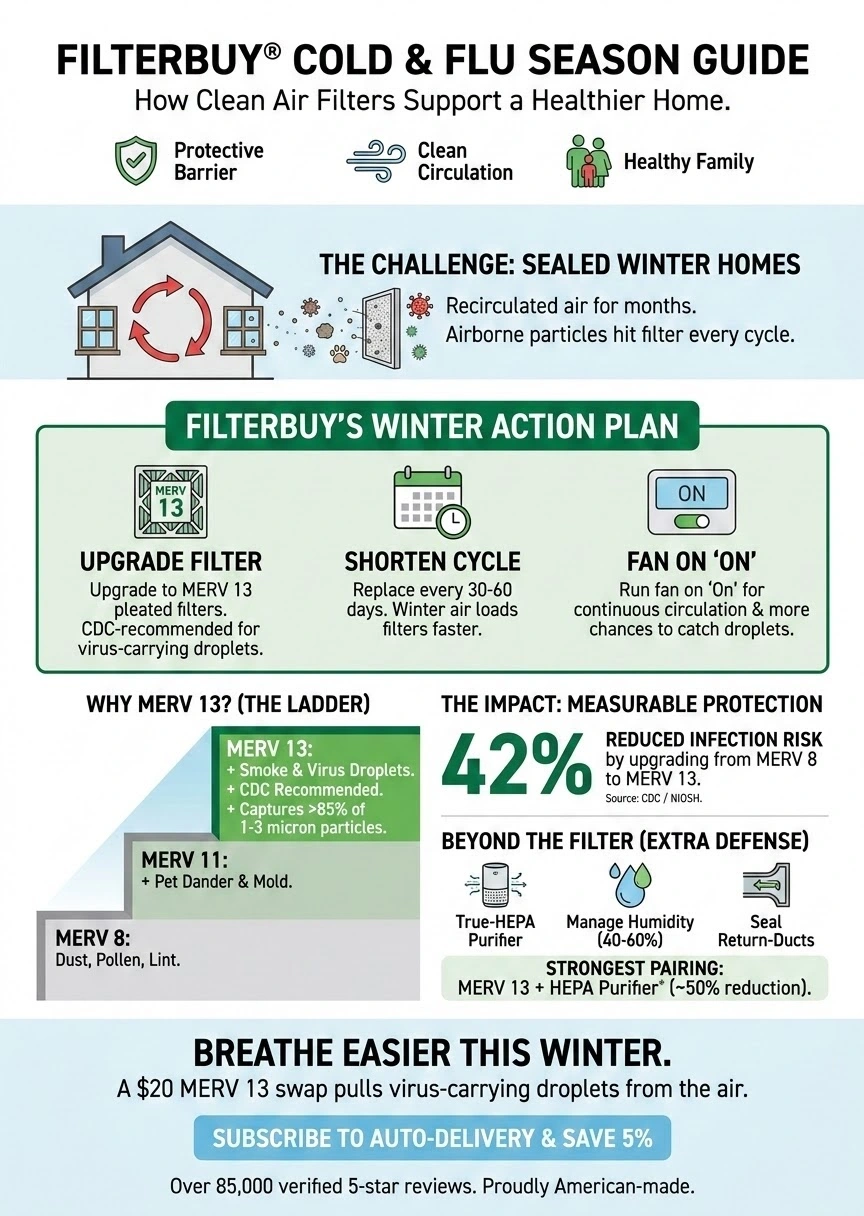
A sealed winter home recirculates the same indoor air for about five months straight. Windows stay shut. Furnaces run day and night. Everything airborne in the house hits your HVAC air filter on every cycle of the blower: dust, pet dander, and the respiratory droplets that carry cold and flu viruses. That’s why the filter you pick for cold and flu season matters more than the one you picked in July. Your replacement cadence matters even more than the filter itself.
For a sealed winter home, the cold and flu filtration setup that actually works is a MERV 13 pleated filter, replaced every 30 to 60 days through heating season, with indoor humidity held between 40 and 60 percent and a true-HEPA purifier in any sickroom. After a decade of helping homeowners through cold and flu season, the biggest gains we see come from shortening the replacement cycle, not from buying a pricier filter.
Upgrade to MERV 13 pleated filters. The CDC-recommended baseline for capturing virus-carrying respiratory droplets.
Replace every 30 to 60 days from October through March. Sealed winter air loads the filter faster than it does in spring or fall.
Run the thermostat fan on "On," not "Auto," when anyone is sick. Continuous circulation gives the filter more chances to catch droplets.
Hold indoor humidity between 40 and 60 percent. Dry winter air keeps droplets airborne longer, and a $15 hygrometer tells you where you actually are.
Add a true-HEPA purifier in the sickroom. Aim for five or more air changes per hour in that one room.
Seal return-duct joints. An unsealed return pulls unfiltered air from attics and crawlspaces, bypassing the filter entirely.
Cold and flu viruses ride on respiratory droplets mostly smaller than 5 microns, and those droplets can stay airborne for hours in a sealed winter home.
A pleated MERV 13 filter captures at least 85 percent of 1 to 3 micron particles per ASHRAE Standard 52.2, and the CDC names it as the residential baseline for virus filtration.
Replace filters every 30 to 60 days during peak heating season, not the factory-default 90 days.
Filtration works best alongside 40 to 60 percent indoor humidity and at least five air changes per hour of clean air.
Pair a whole-home MERV 13 filter with a true-HEPA room purifier in the sickroom for the strongest practical defense.
Air filters don’t catch individual virus particles on their own. A flu virion measures about 0.1 microns across, and a standard pleated filter lets particles that size slip right through. What the filter actually catches is the respiratory droplets that carry those viruses. Coughs, sneezes, and normal breathing all release droplets mostly smaller than 5 microns, and a high-MERV pleated filter is built to grab particles in that range by sieving them out of the airstream, intercepting them against the fibers, and pulling them in with electrostatic charge.
We’ve spent over a decade making air filters in Alabama and talking with customers about winter air quality. Here’s what actually works:
MERV 11 pleated: Captures roughly 65 to 75 percent of 1 to 3 micron particles. A safe upgrade for older HVAC systems or any setup where airflow is already marginal.
MERV 13 pleated: The CDC’s recommended baseline for residential virus filtration. Per ASHRAE Standard 52.2, a MERV 13 captures at least 85 percent of 1 to 3 micron particles and at least 50 percent of 0.3 to 1 micron particles. Most modern residential blowers handle it without strain.
True-HEPA room purifier: Removes 99.97 percent of airborne particles 0.3 microns and larger in the room where it runs. Best placed in a sickroom, a nursery, or a home office where someone spends most of the day.
Activated-carbon (Odor Eliminator): Pleated media paired with a carbon bed. Good for damp basements and laundry rooms where musty VOCs compound the problem alongside airborne spores.
For most modern homes, a MERV 13 pleated filter in the return plus a HEPA purifier in the sickroom is the strongest pairing we see in the field.
MERV 8: Dust, pollen, lint. Fine for homes without allergy or illness concerns.
MERV 11: Everything MERV 8 catches, plus pet dander and mold spores. The “Goldilocks” choice for pet owners and most households.
MERV 13: Everything MERV 11 catches, plus smoke, bacteria, and the droplets that carry cold and flu viruses. This is what we recommend for cold and flu season when your system can support it.
One caveat. A MERV rating higher than your blower was built for restricts airflow the same way a clogged filter does. Check your system’s manual if you’re unsure. For what it’s worth, almost every residential system built in the last decade handles MERV 13 without trouble.
Run a true-HEPA portable purifier alongside your HVAC filter, not in place of it. Put it in the room where the sick person sleeps. Size it to deliver at least five air changes per hour for that room’s square footage, and keep it at least two feet from the walls so airflow isn’t blocked. The EPA recommends placing a portable air cleaner nearest an isolating household member. The closer the clean air is to the source, the less virus escapes into the rest of the house.
Humidity cuts both ways in winter. Dry air lets small respiratory droplets stay airborne longer. Push humidity too high with a whole-home humidifier, past 60 percent, and you’re now growing mold on your coils and inside your filter media. The working range is 40 to 60 percent relative humidity, and a $15 digital hygrometer from any hardware store will tell you where you actually are. Here’s why this belongs on a cold and flu season page: a damp winter HVAC setup cycles mold spores through the same air your family breathes with the cold and flu droplets. That’s the winter mold risk in your HVAC system we cover in its own guide.
Upgrade to a MERV 13 pleated filter. It’s the CDC’s recommended baseline for capturing virus-carrying particles.
Shorten your replacement cycle to 30 to 60 days during heating season. Sealed, recirculating air loads the filter faster than spring or fall does.
Run the fan on “On,” not “Auto,” when someone is sick. Continuous circulation gives the filter more chances to capture droplets.
Keep indoor humidity between 40 and 60 percent. Dry winter air lets droplets stay airborne longer and dries out your nasal defenses.
Add a true-HEPA purifier in the sickroom. Aim for five or more air changes per hour in that space.
Inspect and seal returns and duct joints. An unsealed return pulls unfiltered air from attics or crawlspaces, bypassing even the best filter.
“After more than a decade of making air filters in Alabama, we’ve learned the same thing across every climate zone. A homeowner who changes a MERV 13 filter every 30 to 60 days through cold and flu season will consistently outperform a household running a premium setup nobody remembers to maintain.”
The Filterbuy Team. Talladega, Alabama. Over a decade of U.S. air filter manufacturing. 85,000+ verified five-star customer reviews.
When homeowners call our team with cold and flu air-quality questions, these are the primary sources we reach for. Bookmark them. They’re the evidence behind every recommendation on this page.
CDC: Taking Steps for Cleaner Air for Respiratory Virus Prevention. Start here if you only have time for one outside source. CDC guidance on ventilation, fan settings, and portable HEPA use during respiratory virus season.
CDC / NIOSH: Ventilation FAQs. The technical FAQ on MERV ratings, particle sizes, and how respiratory droplets actually behave indoors. Most of the MERV 13 numbers on this page pull from here.
EPA: Air Cleaners, HVAC Filters, and Coronavirus (COVID-19). EPA guidance on upgrading HVAC filters and placing portable air cleaners, with specific instructions for isolating a sick household member.
ASHRAE: Filtration & Disinfection Resources. ASHRAE wrote the MERV scale (Standard 52.2). If you want the original source for what each rating actually tests against, this is it.
NIH / PMC: A Systematic Review of HVAC Design and Virus Transmission. A peer-reviewed review of 23 filtration studies. It confirms that higher filter efficiency reduces transmission and that MERV 13 is the practical ceiling for most residential systems.
Lawrence Berkeley National Laboratory: Dampness and Mold Scientific Findings Resource Bank. The research program behind the widely cited finding that nearly half of U.S. homes show visible dampness or mold, a condition that compounds everything else on a cold and flu season page.
CDC / NIOSH: Improving Air Cleanliness Through Filtration. CDC guidance on air-cleaning strategies, air-changes-per-hour targets, and when to pair HVAC filtration with a portable HEPA unit.
Indoor air can be two to five times more polluted than outdoor air. That gap only grows in winter, when sealed homes recirculate the same concentrated air for months. Source: EPA, Introduction to Indoor Air Quality.
A MERV 13 filter captures at least 50 percent of particles in the 0.3 to 1.0 micron range and at least 85 percent of particles in the 1 to 3 micron range. That range includes most respiratory virus droplets, which is why the CDC names MERV 13 as the residential baseline. Source: CDC / NIOSH, Ventilation FAQs.
Upgrading from a MERV 8 to a MERV 13 filter cut the estimated probability of infection by 42 percent in controlled indoor-environment testing. Adding a portable HEPA purifier on top of the MERV 13 pushed the reduction closer to 50 percent. Source: Experimental Studies of Particle Removal and Probability of Infection, CDC / NIOSH.
No HVAC filter, at any MERV rating, can prevent a cold or flu infection on its own. Any company telling you otherwise is overselling. What filters actually do is measurable and affordable, and it compounds over a full heating season. Filtration doesn’t replace handwashing, staying home when you’re sick, or the CDC’s layered guidance. But a $20 MERV 13 swap every 30 to 60 days through cold and flu season pulls a real fraction of the virus-carrying droplets out of the air your family actually breathes.
The biggest improvements we see happen in homes where somebody set a monthly reminder, or enrolled in auto-delivery, and actually swapped the filter on time. Buying the right filter is easy. Remembering to change it on schedule is the part that takes real work.
Three things worth doing this week.
Write down your filter size. Open the return grille or the air-handler panel, read the dimensions off the frame (length by width by thickness, such as 20x25x1), and save them to your phone.
Order a three-pack of MERV 13 pleated filters. Three packs cover roughly October through December, which carries you through the peak of cold and flu season without a mid-season store run.
Block ten minutes on the first of every month from October through March. Check the filter. If it looks gray, damp, or warped, swap it even if it hasn’t hit the ninety-day mark.
Yes. High-MERV pleated filters capture the respiratory droplets that carry cold and flu viruses, which lowers airborne concentrations in a sealed home. A MERV 13 pleated filter captures at least 85 percent of 1 to 3 micron particles per ASHRAE Standard 52.2. No filter eliminates infection risk on its own, but it measurably lowers exposure.
The CDC recommends MERV 13 or the highest MERV your HVAC system can safely handle. MERV 13 captures the smallest virus-carrying droplets while most modern residential blowers accept it without airflow issues. Choose MERV 11 if your system is older or if airflow already feels restricted.
Replace pleated filters every 30 to 60 days from October through March, rather than the 90-day default. Sealed winter homes recirculate concentrated dust, pet dander, and virus-carrying droplets, which loads the filter much faster than it does in milder seasons.
Yes. A true-HEPA air purifier removes 99.97 percent of airborne particles 0.3 microns and larger, which includes most flu-carrying droplets. Place one in the room where a sick household member rests, and run it continuously. HEPA purifiers complement your HVAC filter rather than replacing it.
Yes. Switch the thermostat fan from “Auto” to “On” so your HVAC filter keeps cycling room air through the media. The CDC recommends continuous circulation through a MERV 13 filter when anyone in the home is ill or when visitors are present.
No single filter eliminates every viral particle. But upgrading from MERV 8 to MERV 13 can cut the estimated probability of infection by roughly 42 percent in modeled indoor environments. Pair filtration with humidity control and good ventilation for the strongest protection.
The MERV 13 pleated filters we make in Talladega, Alabama catch the droplets that carry cold and flu viruses. They fit almost every residential HVAC system in North America. Shipping is free with no minimum order.
Signing up for Filterbuy Auto-Delivery takes about thirty seconds and saves you five percent on every order. You pick the schedule. Edit, skip, or cancel anytime. Your next filter shows up when you need it, not weeks later.
Over 85,000 five-star customer reviews agree. Breathe easier this winter with Filterbuy, proudly American-made in Talladega, Alabama.

